

-
Research Article
-
Manufacturing Method and Properties of Core and WHD Made of Virgin PP and Recycle PP
신재 및 재활용 폴리프로필렌 소재를 이용한 코어재 및 날개형 수평배수재의 제조방법과 물성 평가
-
Sung-Woo Cho, Im-Rak Lee, Tae-Young Park, Eun-Chul Shin
조성우, 이임락, 박태영, 신은철
- A integrated method of PHD+PVD, “Top-fixed drainage method”, connects the end of an installed PVD to the upper part of PHD and …
현재 적용되고 있는 수평배수재와 수직배수재의 일체화 공법인 상부거치식 배수공법에서 수직배수재를 통해 지표층으로 배출된 지중 간극수는 수평배수재의 필터재 표면에 배출되지만, 필터재의 제한적인 투수율로 …
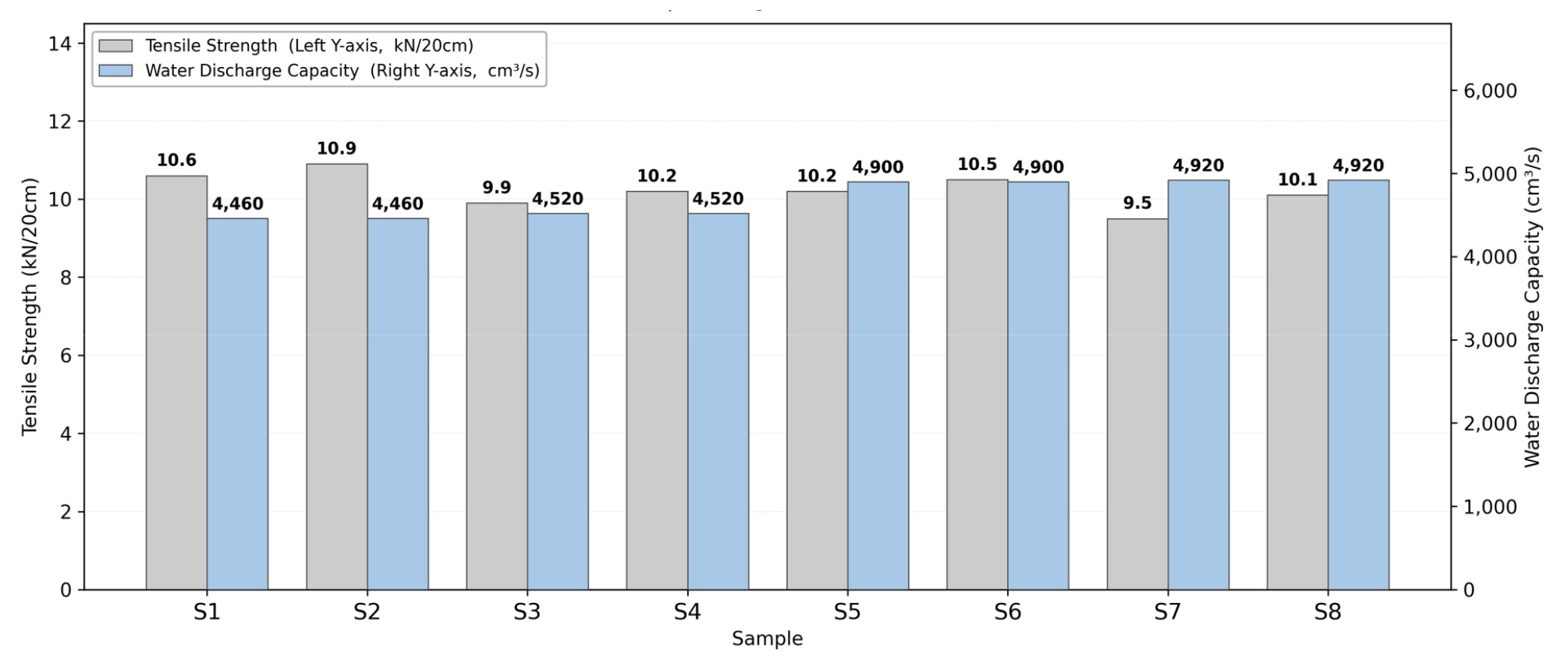
- A integrated method of PHD+PVD, “Top-fixed drainage method”, connects the end of an installed PVD to the upper part of PHD and it may face resistance in drainage due to limited permeability of the filter. Because of this reason, most of the pore water does not pass through the core part(water channel) in PHD and it is dispersed into the nearby ground. Therefore, consolidation time is prolonged while the moisture content of ground increases. In this study, WHD(Wing Horizontal Drain) prototypes have been developed to improve the structural issues of conventional PHD and to minimize the loss of pore water into the ground. A mass-production system for WHD product can be furnished by ensuring stable productivity in the key processes including mount-shape core using a molding roller and ultrasonic thermal bonding between filter and wing 1, 2. Four different prototypes of WHD are manufactured by combining two core materials either virgin or recycle PP with two types of filter, PP and PET nonwoven fabrics. Based on these combined elements, totally 8-prototypes are made with single wing and double wings. The major engineering characteristics such as tensile property and water discharge capacity(WDC) of WHD products are also compared and analyzed. The recycle PP core shows almost no difference in physical properties comparison with the virgin PP core. In addition, a newly designed ‘drainage efficiency device’ is proposed to solve the issues with ‘ASTM D 4716’ and to analyze WDC of WHD+PVD+wing. The newly proposed method is called “Direct insertion drainage method” for testing of WHD+PVD+wing and it can be compared with “Top-fixed drainage method” for testing of PHD+PVD. Based on the laboratory WDC tests, the former drainage method has significantly improved WDC compared to the latter method when the landfill soil conditions of the construction site is especially very poor. The results of water discharge capacity with ‘drainage efficiency device’ indicate that the newly developed WHD contains an innovative wings and hence it can replace effectively the conventional PHD product.
- COLLAPSE
현재 적용되고 있는 수평배수재와 수직배수재의 일체화 공법인 상부거치식 배수공법에서 수직배수재를 통해 지표층으로 배출된 지중 간극수는 수평배수재의 필터재 표면에 배출되지만, 필터재의 제한적인 투수율로 인해 배수저항을 받게 된다. 그 결과, 간극수의 대부분은 수평배수재 코어재(배수유로)로 유입되지 못하고 지중으로 재유실되어 점토지반의 압밀시간이 지연되는 문제가 발생한다. 본 연구에서는 이러한 수평배수재의 구조적 문제를 개선하고 간극수의 유실을 최소화할 수 있는 날개형 수평배수재 시제품을 개발하였다. 주요 핵심공정인 성형로울러에 의한 코어재 단면구조(산형격자)의 성형 및 날개편 1, 2와 필터재의 초음파 열접착에 대한 안정된 생산성 확보를 통해 날개형 수평배수재의 양산시스템을 구축하였다. 날개형 수평배수재(WHD)는 코어재 2종(신재, 재활용 PP)과 필터재 2종(PP, PET 부직포)을 조합해 4종류의 시제품을 생산하였고, 이를 기준으로 한방향과 양방향 날개편을 가지는 최종 8종의 시제품을 제작하여 주요 물성을 비교 분석하였다. 재활용 PP(R-PP) 코어재는 우수한 물성을 나타내었으며 신재 PP(V-PP) 코어재의 물성 대비 유사한 초기 성능을 보였다. 또한, 수평배수성능의 평가를 위해 채택되고 있는 ASTM D 4716 시험법 규격에 대한 문제점을 보완하고자 새로운 배수성능 시험장치를 고안하여 날개형 수평배수재와 수평배수재의 배수성능을 비교 분석하였다. 날개형 수평배수재(직접삽입식 배수공법)은 시공 현장 조건이 가혹할수록 탁월한 배수성능을 유지하였고, 기존 수평배수재(상부거치식 배수공법)를 효과적으로 대체할 혁신적인 공법임을 확인할 수 있었다.
-
Manufacturing Method and Properties of Core and WHD Made of Virgin PP and Recycle PP
-
Research Article
-
Load Transfer Characteristics of Horizontal Support-Replacing Anchors Based on Three-Dimensional Numerical Analysis
3차원 수치해석 기반 수평 지보재 대체 앵커의 하중전달 특성
-
Seung-Il Choi, Da-Bin Kwon, Gyeong-Seok Yu, Se-Rin Kwon, Chang-Jun Kim, Seung-Joo Lee, Chan-Young Park, Yong-Seong Kim
최승일, 권다빈, 유경석, 권세린, 김창준, 이승주, 박찬영, 김용성
- In urban excavation projects, the application of conventional horizontal struts and ground anchors may be limited by restricted site conditions, adjacent structures, …
도심지 굴착공사에서는 제한된 부지 조건과 인접 구조물 및 지중 매설물과의 간섭으로 인해 기존 수평 지보재 및 어스앵커 공법의 적용에 제약이 발생할 수 …
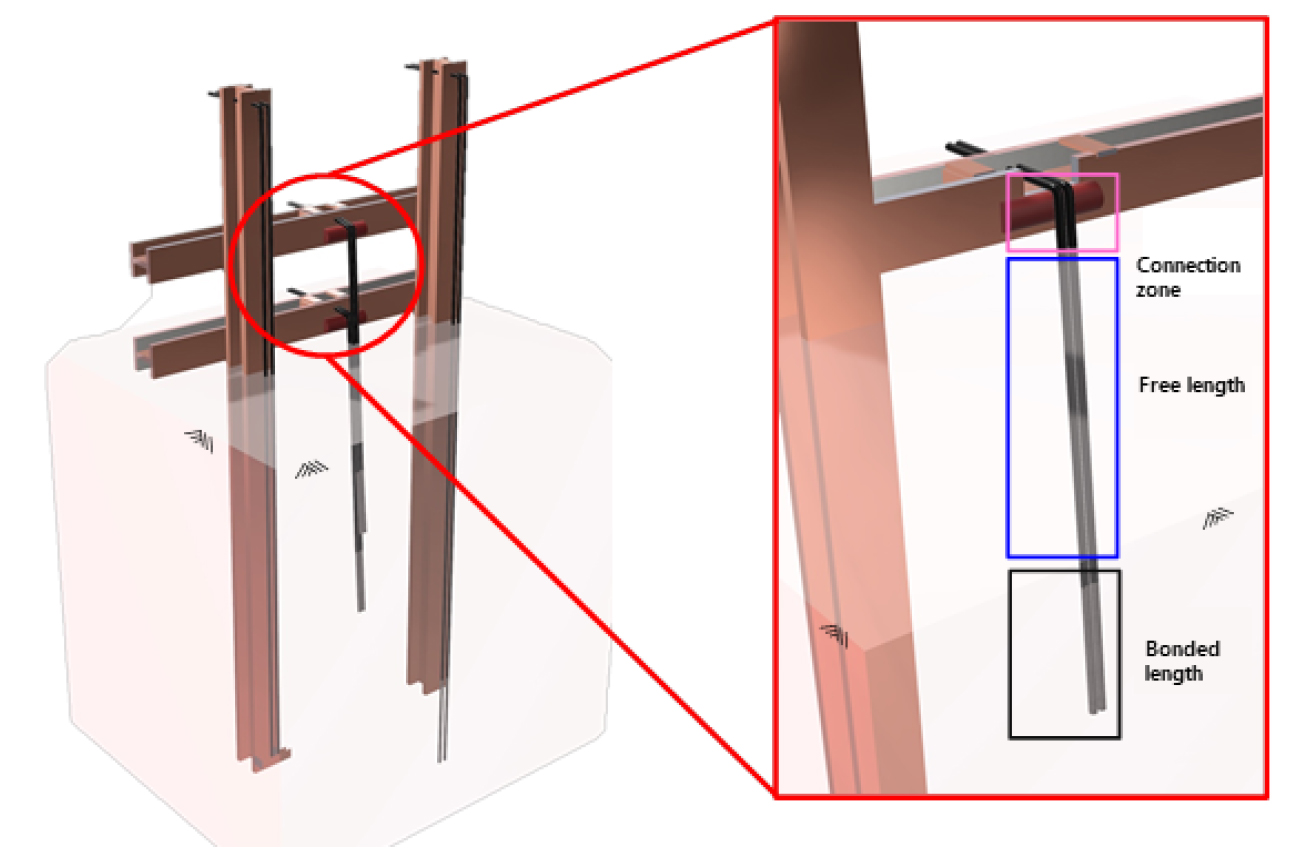
- In urban excavation projects, the application of conventional horizontal struts and ground anchors may be limited by restricted site conditions, adjacent structures, and underground utilities. In this study, the load transfer characteristics of horizontal support-replacing anchors were analyzed using 3D numerical analysis. The main analysis parameters were ground condition, jacking force, center-to-center spacing of soldier piles, anchor inclination angle, cylindrical guide projection length, free length, and bonded length. The results showed that the axial force transferred to the bonded length was generally greater in dense sand than in loose sand, except in some high-inclination cases, and the transferred load generally increased as the jacking force increased. At an anchor inclination of 80° under a jacking force of 100kN, reducing the cylindrical guide projection length from 300mm to 100mm increased the axial force at the start of the bonded length from 55.8kN to 86.6kN. However, the load transfer efficiency varied depending on ground condition, anchor inclination angle, free length, bonded length, and cylindrical guide projection length. Therefore, the design of horizontal support-replacing anchors should comprehensively consider ground condition, anchor inclination angle, jacking force, and anchorage conditions.
- COLLAPSE
도심지 굴착공사에서는 제한된 부지 조건과 인접 구조물 및 지중 매설물과의 간섭으로 인해 기존 수평 지보재 및 어스앵커 공법의 적용에 제약이 발생할 수 있다. 본 연구에서는 3차원 수치해석을 이용하여 수평 지보재 대체 앵커의 하중전달 특성을 분석하였다. 주요 해석 변수는 지반조건, 긴장력(jacking force), 엄지말뚝 중심간격, 앵커 설치각, 원통형 가이드 돌출길이, 자유장 및 정착장 길이로 설정하였다. 해석 결과, 조밀한 지반에서는 대체로 느슨한 지반보다 정착장으로 전달되는 축력이 크게 나타났으나, 일부 고각 조건에서는 상이한 경향을 보였다. 긴장력이 증가할수록 전달하중은 전반적으로 증가하였다. 특히 긴장력 100kN 및 앵커 설치각 80° 조건에서 원통형 가이드 돌출길이를 300mm에서 100mm로 감소시킬 경우 정착장 시작부 전달축력은 55.8kN에서 86.6kN으로 증가하였다. 그러나 하중전달 효율은 지반조건, 앵커 설치각, 자유장 및 정착장 길이, 원통형 가이드 돌출길이에 따라 달라졌다. 따라서 수평 지보재 대체 앵커의 설계 시에는 지반조건, 앵커 설치각, 도입 긴장력 및 정착 조건을 종합적으로 검토할 필요가 있다.
-
Load Transfer Characteristics of Horizontal Support-Replacing Anchors Based on Three-Dimensional Numerical Analysis
-
Research Article
-
Probabilistic Stability Assessment and Fragility Curve Development for Multiple River Embankment Cross-Sections under Water-Level Fluctuations
수위 변동에 따른 국내 하천 제방 다수 단면의 확률론적 안정성 평가 및 취약도 곡선 작성
-
Jong-Won Lee, Jin-Tae Han, Duhan Lee, Seokjung Kim, Dong-Chan Kim, Sung-Eun Cho
이종원, 한진태, 이두한, 김석중, 김동찬, 조성은
- This study evaluated the time-dependent stability and relative fragility of 24 cross-sections obtained from investigation data for a river embankment along the …
본 연구에서는 국내 ○○천 제방 조사자료에 근거한 24개 단면을 대상으로 수위 변동에 따른 시간의존적 안정성과 상대적 취약성을 평가하였다. Slide2를 사용하여 유한요소법에 의한 …
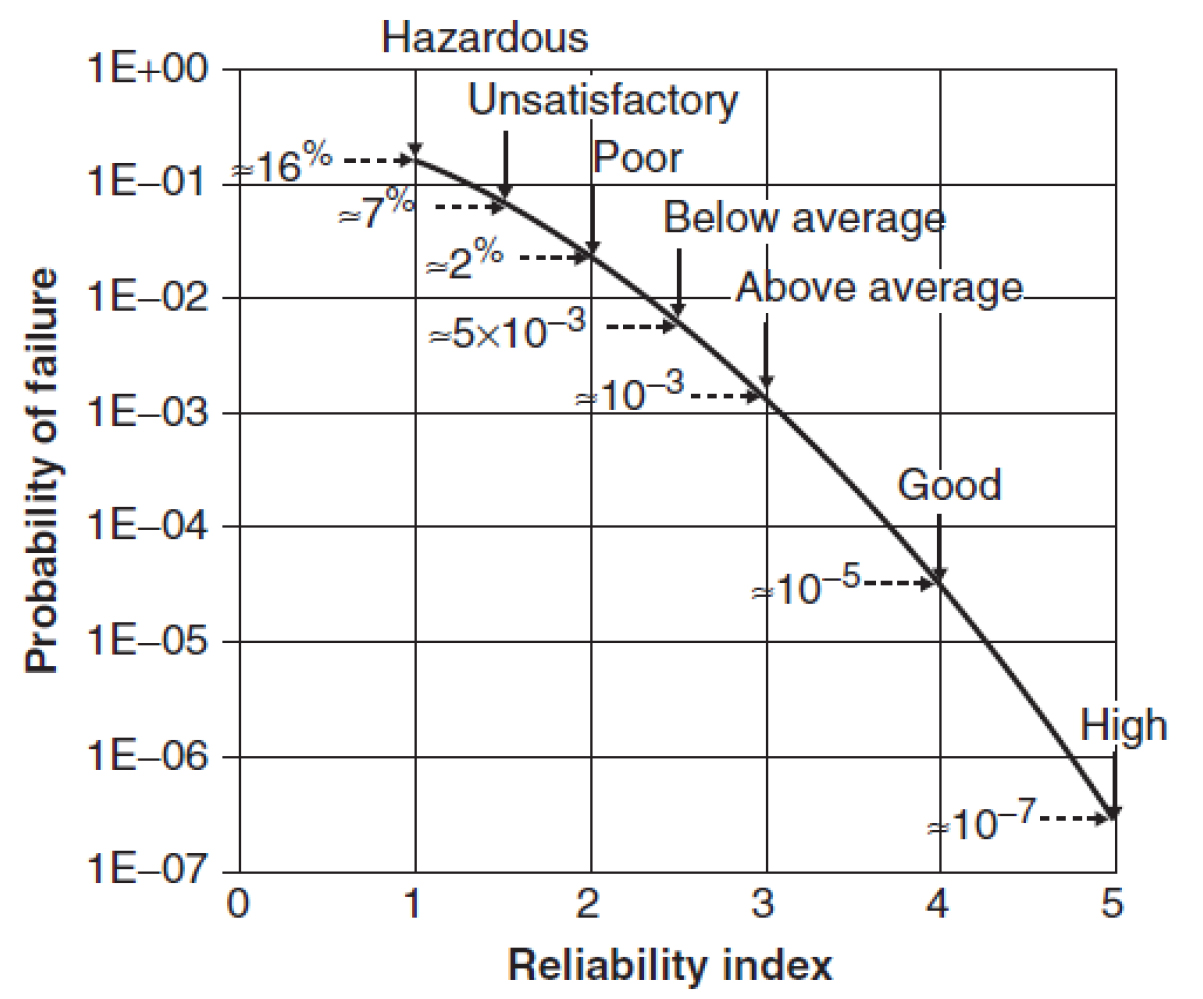
- This study evaluated the time-dependent stability and relative fragility of 24 cross-sections obtained from investigation data for a river embankment along the ○○ River in Korea under water-level fluctuations. Using Slide2, transient seepage analysis was performed based on the finite element method to determine the time-dependent pore-water pressure distributions. The results were then coupled with limit equilibrium analyses to conduct deterministic and probabilistic slope stability assessments. Cohesion and friction angle were modeled as independent lognormally distributed random variables, and a response surface based on polynomial chaos expansion (PCE) was employed to improve computational efficiency. To screen representative vulnerable sections, 50,000 Monte Carlo simulations (MCS) were conducted at each time step for all 24 cross-sections. CS-01 and CS-22, which exhibited maximum probabilities of failure of 40.1% and 60.5%, respectively, were selected as the representative vulnerable sections. Rather than directly comparing the failure probabilities of the two sections, their time-dependent stability and fragility were evaluated separately by varying the initial water level, H, under the water-level conditions assigned to each section. For each initial water-level condition, 100,000 MCS were conducted at every time step, and fragility curves were developed to represent the relationship between the initial water level and the maximum probability of failure during the corresponding water-level history. The maximum probability of failure increased to 71.9% for CS-01 and 86.9% for CS-22. The critical conditions of the two cross-sections occurred either during the transient rapid-drawdown stage, when the stabilizing effect of external water pressure decreased rapidly while the dissipation of pore-water pressure within the embankment was delayed, or at the end of the drawdown. The developed fragility curves can support the relative screening of multiple embankment cross-sections under a consistent dataset and analytical framework and may assist in prioritizing detailed investigations and reinforcement measures.
- COLLAPSE
본 연구에서는 국내 ○○천 제방 조사자료에 근거한 24개 단면을 대상으로 수위 변동에 따른 시간의존적 안정성과 상대적 취약성을 평가하였다. Slide2를 사용하여 유한요소법에 의한 비정상 침투해석을 수행하고 시간별 간극수압 분포를 산정한 후, 그 결과를 연계하여 한계평형법 기반의 결정론적 및 확률론적 사면안정해석을 수행하였다. 점착력과 내부마찰각은 서로 독립인 대수정규 확률변수로 고려하였으며, 계산 효율을 높이기 위해 다항식 카오스 전개(PCE) 기반 응답면을 적용하였다. 대표 취약 단면 선별을 위해 24개 단면의 각 시간 단계에서 50,000회의 몬테카를로 시뮬레이션(MCS)을 수행하였으며, 최대 파괴확률이 각각 40.1%와 60.5%로 나타난 CS-01과 CS-22를 대표 취약 단면으로 선정하였다. 이후 두 단면의 파괴확률을 직접 비교하기보다, 각 단면에 적용된 수위 조건에서 초기수위 H의 변화에 따른 시간의존적 안정성과 취약성을 개별적으로 분석하였다. 각 초기수위 조건의 시간 단계마다 100,000회의 MCS를 수행하고, 초기수위와 수위 이력 중 최대 파괴확률의 관계를 나타내는 취약도 곡선을 작성하였다. 해석 결과, 최대 파괴확률은 CS-01에서 71.9%, CS-22에서 86.9%까지 증가하였다. 두 단면의 임계상태는 외부수압의 지지효과가 빠르게 감소하는 반면 제체 내부 간극수압의 소산은 지연되는 수위 급강하 과정의 과도상태 또는 수위 급강하 종료 시점에서 발생하였다. 본 연구에서 작성한 취약도 곡선은 동일한 자료와 해석체계에서 다수 제방 단면의 상대적 취약성을 선별하고, 정밀조사 및 보강 우선순위를 결정하는 데 활용될 수 있다.
-
Probabilistic Stability Assessment and Fragility Curve Development for Multiple River Embankment Cross-Sections under Water-Level Fluctuations
-
Research Article
-
A Study on the Proposal of Empirical Coefficients for Settlement Estimation of Embedded Piles in Weathered Ground
매입말뚝공법의 침하량 산정을 위한 풍화대 지반의 경험계수 제안 연구
-
Seungtyul Oh, Tae-Hyung Kim, Chea min Kim, Kihwan Kim
오승률, 김태형, 김채민, 김기환
- As architectural and civil engineering structures continue to increase in scale, pile foundations are required to support increasingly larger structural loads. In …
최근 건축 및 토목 구조물이 대형화됨에 따라 상부 구조물을 지지하는 말뚝기초에도 큰 하중을 지지할 수 있는 성능이 요구되고 있다. 국내에서는 시공성과 환경적 …
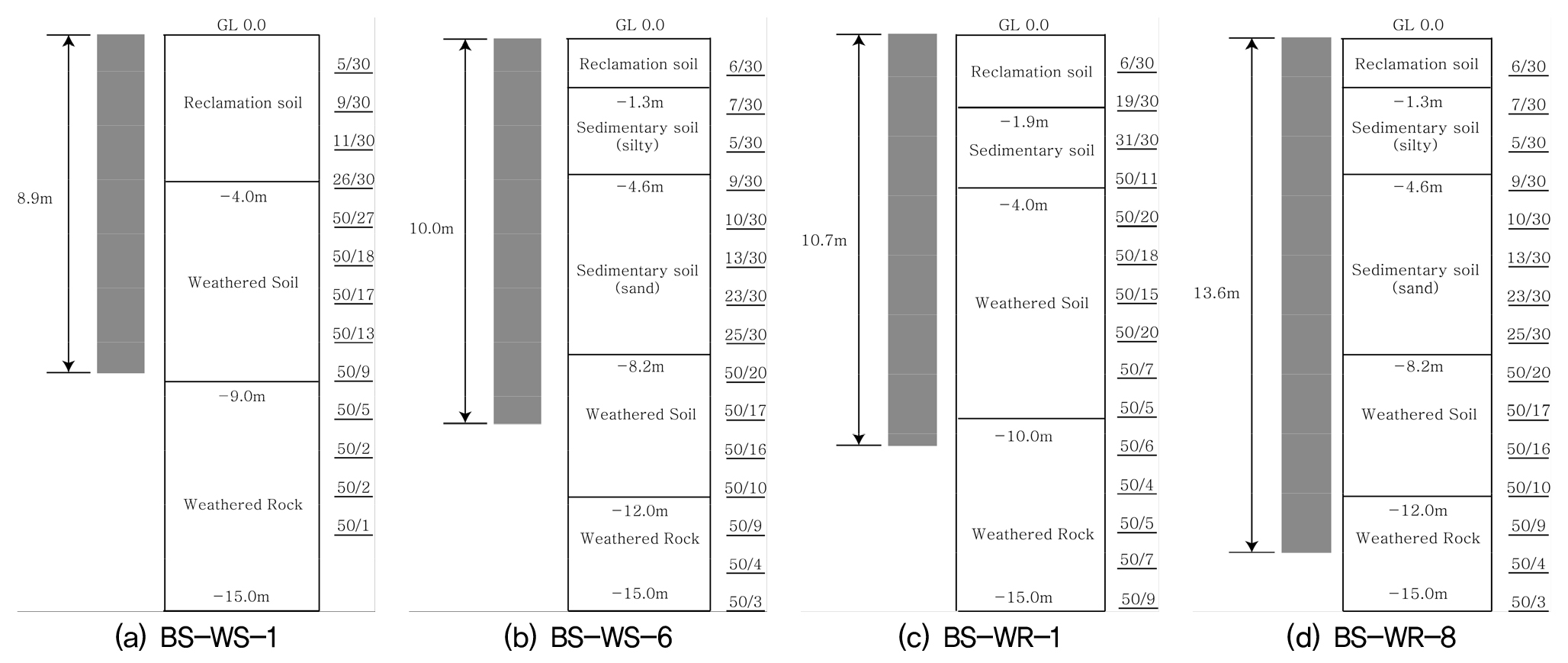
- As architectural and civil engineering structures continue to increase in scale, pile foundations are required to support increasingly larger structural loads. In Korea, embedded piles using PHC and steel pipe piles are widely used because of their constructability and relatively low environmental impact. The settlement of embedded piles is generally estimated using Vesic's empirical equation. However, the empirical coefficients proposed by Vesic were primarily developed for soil conditions and are also commonly applied to weathered ground. In this study, the results of static pile load tests and load-transfer tests conducted on embedded piles installed in weathered soil and weathered rock were analyzed. The measured settlements were compared with those calculated using Vesic's settlement equation, and the calculated settlements were found to be approximately 3.1 to 7.8 times greater than the measured values. Accordingly, empirical coefficients suitable for weathered ground were back-calculated using the measured settlements and load-sharing ratios between shaft resistance and tip resistance. Based on the analysis, empirical coefficients of 0.042 and 0.033 are proposed for weathered soil and weathered rock, respectively. The proposed coefficients are expected to improve the applicability of Vesic's settlement equation to weathered ground and provide a more rational basis for settlement estimation of embedded piles.
- COLLAPSE
최근 건축 및 토목 구조물이 대형화됨에 따라 상부 구조물을 지지하는 말뚝기초에도 큰 하중을 지지할 수 있는 성능이 요구되고 있다. 국내에서는 시공성과 환경적 영향을 고려하여 PHC말뚝 및 강관말뚝을 이용한 매입말뚝공법이 널리 적용되고 있다. 본 연구에서는 풍화토 및 풍화암 지반에 근입된 매입말뚝을 대상으로 수행된 압축정재하시험과 하중전이시험 결과를 분석하고, 실제 시험 침하량과 Vesic의 침하량 산정식으로 계산된 침하량을 비교하였다. 분석 결과, 일반적인 사질토 지반의 경험계수 0.09를 적용하여 계산된 침하량은 시험 침하량보다 약 3.1~7.8배 크게 나타났다. 이에 시험에서 측정된 침하량과 주면마찰력 및 선단지지력의 하중분담율을 이용하여 풍화대 지반에 적합한 경험계수를 역산하였다. 그 결과, 풍화토 지반에서는 0.042, 풍화암 지반에서는 0.033의 경험계수를 제안하였다. 본 연구에서 제안한 경험계수는 풍화대 지반에서 기존 Vesic 경험계수의 적용에 따른 과도한 침하량 산정을 개선하고, 매입말뚝의 침하량을 보다 합리적으로 산정하기 위한 참고값으로 활용될 수 있을 것으로 판단된다.
-
A Study on the Proposal of Empirical Coefficients for Settlement Estimation of Embedded Piles in Weathered Ground
-
Research Article
-
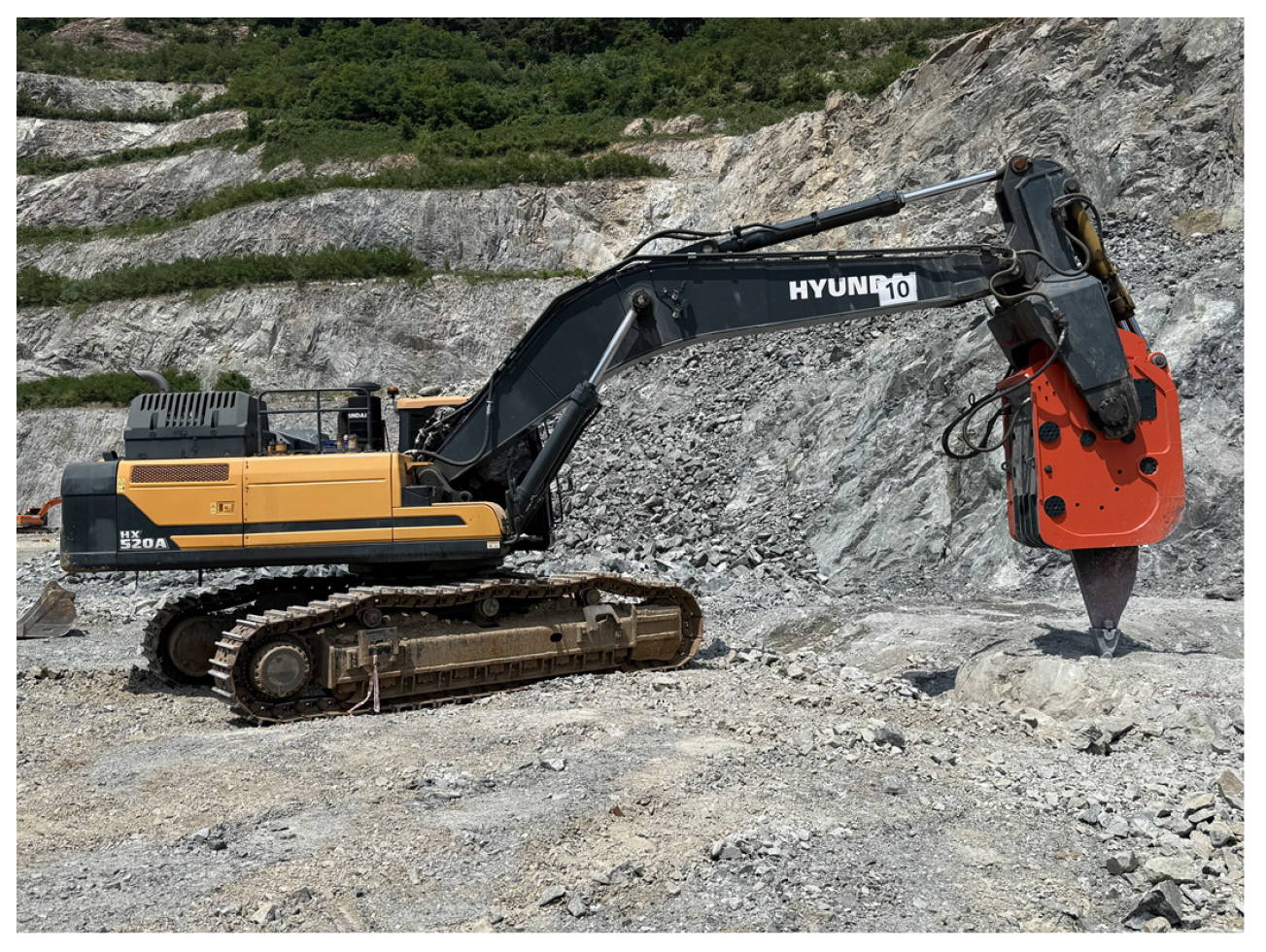
Evaluation of Excavation Characteristics of a Vibratory Ripper Based on Field Excavation Tests
현장 굴착시험을 통한 진동 리퍼의 굴착 특성 평가
-
Mingyu Kim, Jahe Jung, Chulho Lee
김민규, 정자혜, 이철호
- This study evaluated the field excavation performance and applicability of an excavator-mounted vibratory ripper through field excavation tests conducted at five test …
본 연구에서는 굴삭기 어태치먼트형 진동 리퍼의 현장 굴착성능과 적용특성을 평가하기 위하여 발파 채석이 진행 중인 충청남도 당진의 노천광산 내 5개 시험지점에서 동일한 …
- This study evaluated the field excavation performance and applicability of an excavator-mounted vibratory ripper through field excavation tests conducted at five test sites in an open-pit quarry in Dangjin, Chungcheongnam-do, Korea, under identical equipment and operator conditions. Excavation volumes and hourly excavation productivity based on net excavation time were determined from 3D laser scanning of the ground surface before and after excavation, and the borehole-averaged uniaxial compressive strength (UCS) and rock quality designation (RQD) obtained from boreholes at each excavation location were examined in relation to the measured productivity. Image-based fragmentation analysis was performed on the excavated rock to compare fragment size characteristics among the test sites, and noise and ground vibration generated during excavation were measured at selected sites approximately 10m from the vibratory ripper and compared with the domestic regulatory limits for construction noise and vibration. The excavation productivity ranged from 15.05 to 65.97m3/hr, showing an approximately fourfold difference among the test sites under identical equipment conditions, but this variation could not be consistently explained by the borehole-averaged UCS (59.19–163.99MPa) and RQD (58.7–85.0%) alone, which is attributed to the limited ability of borehole indices averaged over a 10m depth to represent the local strength and discontinuity conditions of the shallow rock mass actually excavated. The fragmented rock exhibited relatively uniform size distributions regardless of the test site, with D50 of 116.32–239.87mm and Rosin–Rammler uniformity indices of 1.91–2.28. Ground vibration measured at 10m remained within the regulatory limits, with a maximum peak vector sum of 2.97mm/s and vertical vibration levels (L10) of 58.50–62.35dB(V), whereas the equivalent continuous sound levels of 81.58–83.73dB(A) exceeded the limits, indicating that sufficient separation distance or noise mitigation is required. By integrating the measured productivity, rock mass properties, fragmentation characteristics, and noise and vibration results, this study evaluates the field performance and applicability of the vibratory ripper and presents the validity and limitations of borehole-based rock mass indices for productivity prediction.
- COLLAPSE
본 연구에서는 굴삭기 어태치먼트형 진동 리퍼의 현장 굴착성능과 적용특성을 평가하기 위하여 발파 채석이 진행 중인 충청남도 당진의 노천광산 내 5개 시험지점에서 동일한 장비와 작업자 조건으로 현장 굴착시험을 수행하였다. 굴착 전·후 지형을 3D 레이저 스캔으로 측정하여 시험지점별 굴착체적과 순굴착시간 기준의 시간당 굴착생산량을 산정하였으며, 굴착시험과 동일한 위치의 시추공에서 확보한 시추공 평균 UCS와 RQD를 이용하여 암반특성과 굴착생산량의 관계를 검토하였다. 또한 굴착 후 형성된 파쇄암을 대상으로 영상 기반 입도분석을 수행하여 시험지점별 파쇄입도 특성을 비교하였으며, 일부 시험지점에서는 진동 리퍼로부터 약 10m 이격된 위치에서 굴착 중 발생하는 소음과 지반진동을 계측하여 생활소음·진동 규제기준과 비교하였다. 시험 결과 굴착생산량은 15.05~65.97m3/hr로 동일한 장비조건에서도 시험지점 간 약 4배의 차이를 보였으나, 시추공 평균 UCS(59.19~163.99MPa)와 RQD(58.7~85.0%)만으로는 이러한 차이를 일관되게 설명할 수 없었다. 이는 심도 10m 구간을 평균한 시추공 지표가 실제 굴착이 이루어진 천부 암반의 국부적인 강도와 불연속면 조건을 충분히 반영하지 못하기 때문으로 판단된다. 파쇄암의 D50은 116.32~239.87mm, Rosin–Rammler 분포형상지수 n은 1.91~2.28로 시험지점에 관계없이 비교적 균일한 입도분포를 나타내었고, 10m 이격거리에서 계측한 지반진동은 PVS 최대 2.97mm/s, 수직방향 진동레벨 L10 58.50~62.35dB(V)로 규제기준 이내였으나 등가소음도는 81.58~83.73dB(A)로 기준을 상회하여 이격거리 확보 또는 방음대책이 필요한 것으로 나타났다. 본 연구는 실제 암반조건에서 측정된 굴착생산량과 암반특성, 파쇄입도 및 소음·진동 결과를 종합하여 진동 리퍼의 현장 굴착성능과 적용특성을 평가하고, 시추코어 기반 암반지표를 이용한 생산량 예측의 유효성과 한계를 제시하였다.
-
Evaluation of Excavation Characteristics of a Vibratory Ripper Based on Field Excavation Tests
-
Research Article
-
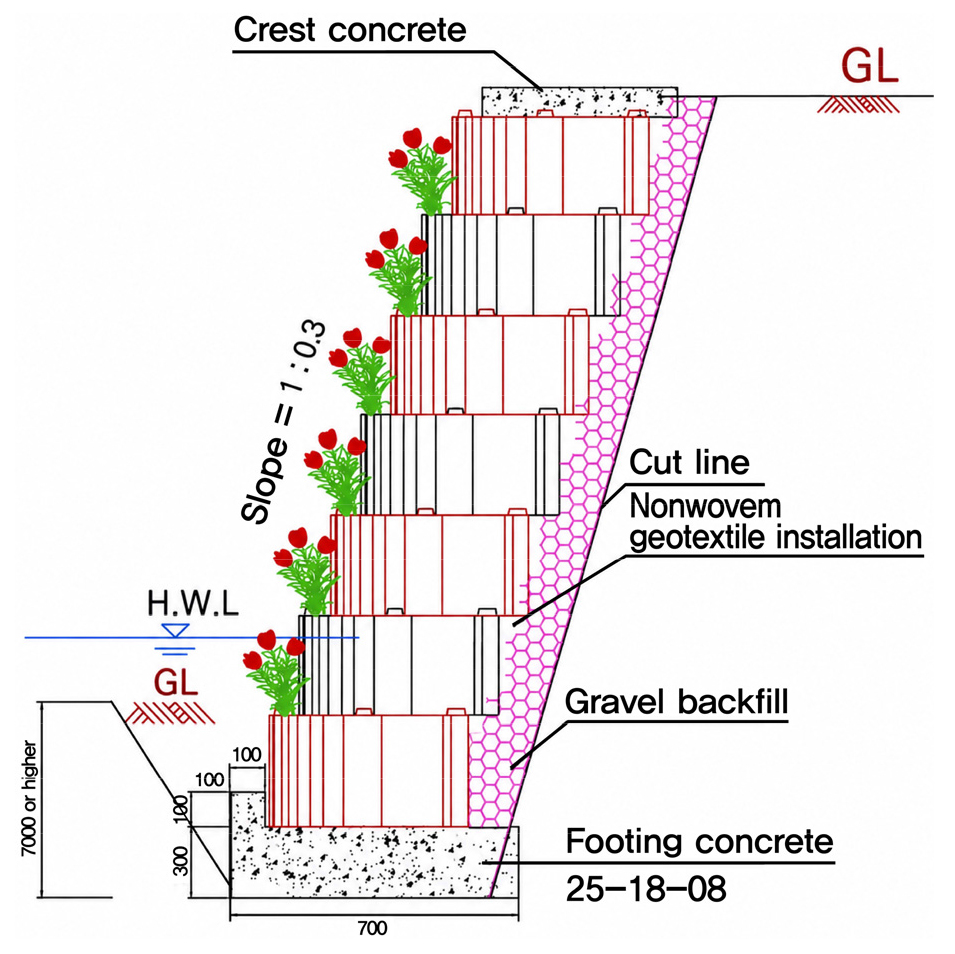
A Numerical Study on the Stability Evaluation of Block-Type Retaining Walls Considering the Shear Characteristics of Block Interfaces
블록 접촉면 전단특성을 고려한 블록식 옹벽의 안정성 평가에 관한 수치해석적 연구
-
Sang-Yeoub Lee, Jeong-Yong Park, Woo-Jin Han, Seong-Yeol Kim, Young Chul Koo, Jaemyeong Bae, Dookie Kim
이상엽, 박정용, 한우진, 김성렬, 구영철, 배재명, 김두기
- Vegetated block retaining walls are constructed by stacking individual blocks and may therefore exhibit relative displacement and localized sliding along the block …
식생블록 옹벽은 개별 블록을 적층하여 축조하므로 블록 접촉면에서 상대변위와 국부적인 활동이 발생할 수 있다. 그러나 기존 해석에서는 옹벽 전체를 하나의 구조체로 가정하는 …
- Vegetated block retaining walls are constructed by stacking individual blocks and may therefore exhibit relative displacement and localized sliding along the block interfaces. However, conventional analyses often assume that the entire wall behaves as an integrated structure, which may result in inaccurate estimations of the resisting moment and wall displacement. In this study, the shear characteristics obtained from direct shear tests on block interfaces were incorporated into three-dimensional finite element models. The resisting moments and horizontal displacements obtained from an integrated model and an interface model were compared. The factors of safety against sliding for integrated and individual block behavior were also evaluated using the trial wedge method. For a 5m-high wall, the resisting moment calculated using the integrated model was 4.09 times greater at the top course and 1.49 times greater at the bottom course than that calculated using the interface model. The maximum top displacement of the interface model was 4.34 times that of the integrated model. For a 7m-high wall, the top displacement exceeded the allowable limit of H/200 by approximately 32.4%. The factor of safety for individual behavior under the block–block condition was approximately 0.86–0.93 times that for integrated behavior. In contrast, the block–pad–key–block condition increased the factor of safety to approximately 1.46–1.57 times that for integrated behavior. The shear connection elements improved the factor of safety by approximately 1.58–1.73 times compared with the block–block condition. The factor of safety increased as the wall slope became gentler; however, under a surcharge load of 10kPa, the block–block condition did not satisfy the required factor of safety of 1.5 at slopes steeper than or equal to 1:0.2. These results demonstrate that the shear characteristics of block interfaces, shear keys, wall slope, and surcharge load should be considered together for the rational stability evaluation of vegetated block retaining walls.
- COLLAPSE
식생블록 옹벽은 개별 블록을 적층하여 축조하므로 블록 접촉면에서 상대변위와 국부적인 활동이 발생할 수 있다. 그러나 기존 해석에서는 옹벽 전체를 하나의 구조체로 가정하는 경우가 많아 실제 저항성능과 변위를 적절하게 평가하지 못할 가능성이 있다. 본 연구에서는 직접전단시험에서 도출된 블록 접촉면의 전단특성을 적용하여 일체형 모델과 인터페이스 모델에 대한 3차원 유한요소해석을 수행하고, 시행쐐기법을 이용하여 일체거동과 개별거동의 활동 안전율을 비교하였다. 높이 5m인 옹벽에서 일체형 모델의 저항모멘트는 인터페이스 모델보다 최상단에서 4.09배, 최하단에서 1.49배 크게 산정되었다. 인터페이스 모델의 상부 변위는 일체형 모델보다 최대 4.34배 증가하였으며, 높이 7m인 옹벽에서는 허용변위 H/200을 약 32.4% 초과하였다. 활동 안정성 검토 결과, 전단키가 없는 블록–블록 조건의 개별거동 안전율은 일체거동의 약 0.86∼0.93배로 나타났다. 반면 블록–패드–키–블록 조건에서는 약 1.46∼1.57배로 증가하였으며, 전단 접합요소의 적용으로 활동 안전율이 블록–블록 조건보다 약 1.58∼1.73배 향상되었다. 또한 옹벽 경사가 완만해질수록 활동 안전율은 증가하였으나, 상재하중 10kPa 조건에서는 경사 1:0.2 이하의 블록–블록 개별거동 안전율이 기준값 1.5에 미달하였다. 이러한 결과는 식생블록 옹벽의 합리적인 안정성 평가를 위해 블록 접촉면의 전단특성, 전단키, 옹벽 경사 및 상재하중을 함께 고려해야 함을 보여준다.
-
A Numerical Study on the Stability Evaluation of Block-Type Retaining Walls Considering the Shear Characteristics of Block Interfaces
-
Research Article
-
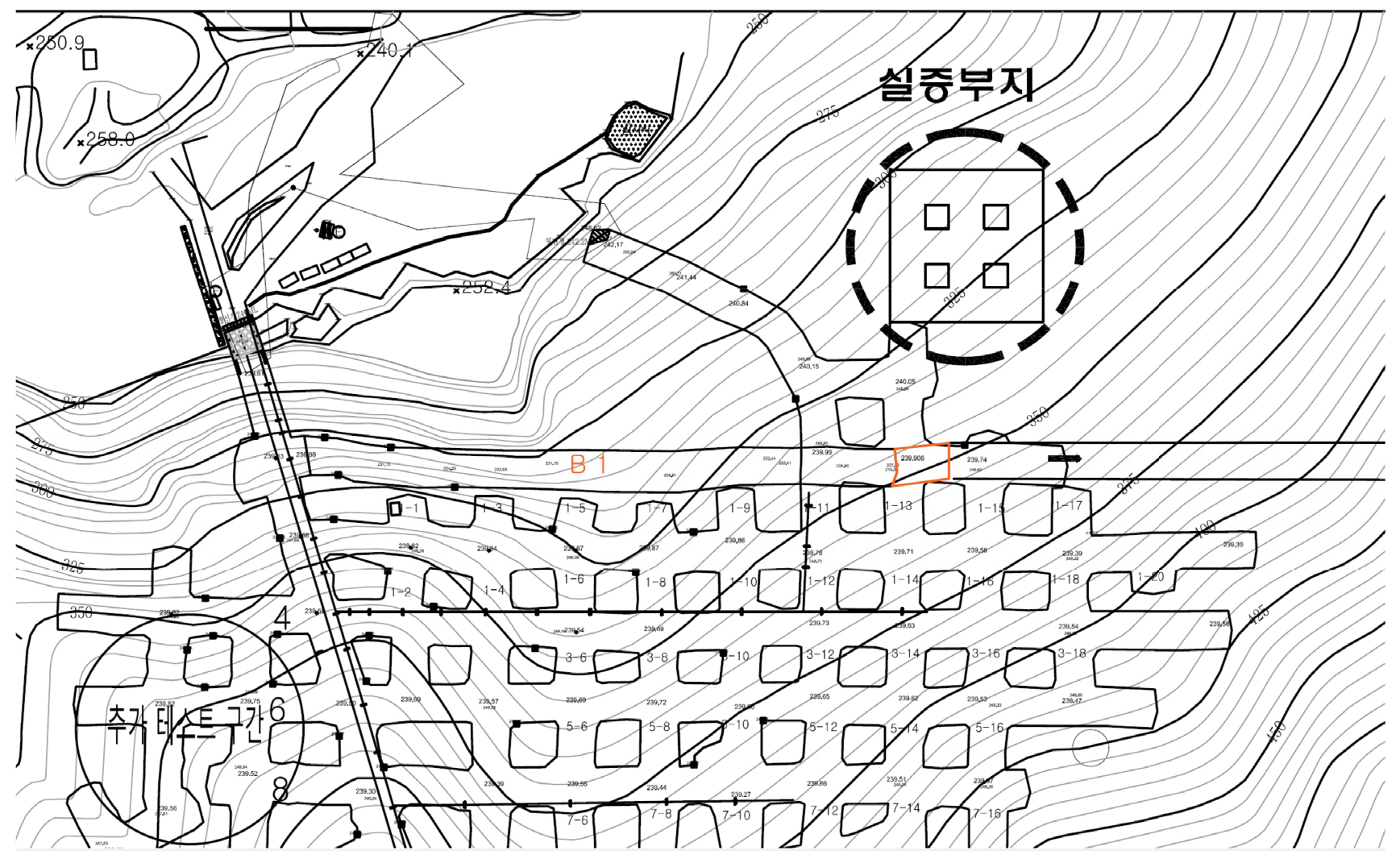
Design and Construction of a Room-and-Pillar Pilot Underground Space and Evaluation of Roof Deformation by 3D Scan Point-Cloud Comparison
격자형 지하공간 파일럿 테스트의 설계 및 시공과 3D 스캔 점군 비교에 의한 천정부 변형 검토
-
Chulho Lee
이철호
- The room-and-pillar (grid-type) method forms an underground space by leaving in-situ rock as pillars and allows the space to be expanded during …
주방식(격자형) 공법은 원지반 암반을 암주로 남겨 지하공간을 형성하는 공법으로, 운영 중에도 공간을 확장할 수 있다는 특징을 갖는다. 선행 연구에서 암주의 강도응력비와 천정부 …
- The room-and-pillar (grid-type) method forms an underground space by leaving in-situ rock as pillars and allows the space to be expanded during operation. A design procedure based on the strength–stress ratio of pillars and the critical strain of the roof has been proposed in previous studies, but a field-scale space designed by this procedure has not been constructed and its long-term behavior has not been reported. In this study, a pilot room-and-pillar space with four 8 × 8m pillars and 12m wide, 8m high rooms was designed and constructed by drill-and-blast excavation in an operating granite aggregate mine in Gyeongsan, Korea. The roof and pillar surfaces were compared after approximately one year using a photogrammetric point cloud (first epoch) and a terrestrial laser scan (second epoch). Since no absolute control points were available, the two point clouds were registered on the pillar surfaces, and the cloud-to-cloud (C2C) distances along four roof spans between pillars and two central roof profiles were expressed as displacements of the roof relative to the pillars. A level of detection of about 10mm was defined from the specified accuracy of the two sensors and the registration residual on the pillars (±3mm). The space remained unsupported throughout the monitoring period. The relative displacements of the roof spans remained within about ±8mm and those of the pillar faces within ±3mm, all below the level of detection, indicating that no significant deformation of the roof relative to the pillars occurred during the monitoring period. The pillar-based registration and level-of-detection procedure presented in this study is expected to be applicable to long-term monitoring of unsupported room-and-pillar spaces where point-wise instrumentation is impractical.
- COLLAPSE
주방식(격자형) 공법은 원지반 암반을 암주로 남겨 지하공간을 형성하는 공법으로, 운영 중에도 공간을 확장할 수 있다는 특징을 갖는다. 선행 연구에서 암주의 강도응력비와 천정부 한계변형률에 기반한 주방식 지하구조 설계법이 제안되었으나, 이 설계법으로 실제 규모의 공간을 건설하고 장기 거동을 확인한 사례는 보고되지 않았다. 본 연구에서는 경북 경산의 가행 화강암 골재광산에 암주 8 × 8m, 룸 폭 12m·높이 8m의 파일럿 테스트 공간을 설계하고 발파 굴착으로 건설하였으며, 약 1년의 시차를 두고 취득한 사진측량 점군과 지상 레이저 스캔 점군을 비교하여 천정부와 암주면의 형상 변화를 검토하였다. 절대 기준점이 없는 조건이므로 두 점군을 암주면 기준으로 정합하고, 암주 사이 천정부 4개 구간과 중앙부 2개 프로파일의 C2C(cloud-to-cloud) 거리를 암주에 대한 천정부의 상대 변위로 산정하였다. 두 센서의 사양 정확도와 암주면 정합 잔차(±3mm)로부터 약 10mm의 검출 한계를 정의하였으며, 관측 기간 중 공간은 무지보 상태로 유지되었다. 천정부 구간의 상대 변위는 ±8mm 이내, 암주면은 ±3mm 이내로 모두 검출 한계 미만으로 나타나, 관측 기간 중 암주에 대한 천정부의 유의한 변형은 발생하지 않은 것으로 판단되었다. 본 연구에서 제시한 암주면 기준 정합과 검출 한계 산정 절차는 계측기 설치가 어려운 무지보 주방식 지하공간의 장기 모니터링과 정밀 계측 위치 선정에 활용될 수 있을 것으로 기대된다.
-
Design and Construction of a Room-and-Pillar Pilot Underground Space and Evaluation of Roof Deformation by 3D Scan Point-Cloud Comparison

Journal Informaiton
 Journal of the Korean Geosynthetics Society
Journal of the Korean Geosynthetics Society








 Korean Geosythetics Society
한국지반신소재학회
#1003, Hyundai Hyel, 213-12 Saechang-ro, Yongsan-gu, Seoul 04376, Korea
Tel: +82-2-583-2167 / Fax: +82-2-3295-2168 / E-mail: kgss-adm@kgss.or.kr Copyright© Korean Geosythetics Society. Powered by APUB
Tel: +82-2-583-2167 / Fax: +82-2-3295-2168 / E-mail: kgss-adm@kgss.or.kr Copyright© Korean Geosythetics Society. Powered by APUB